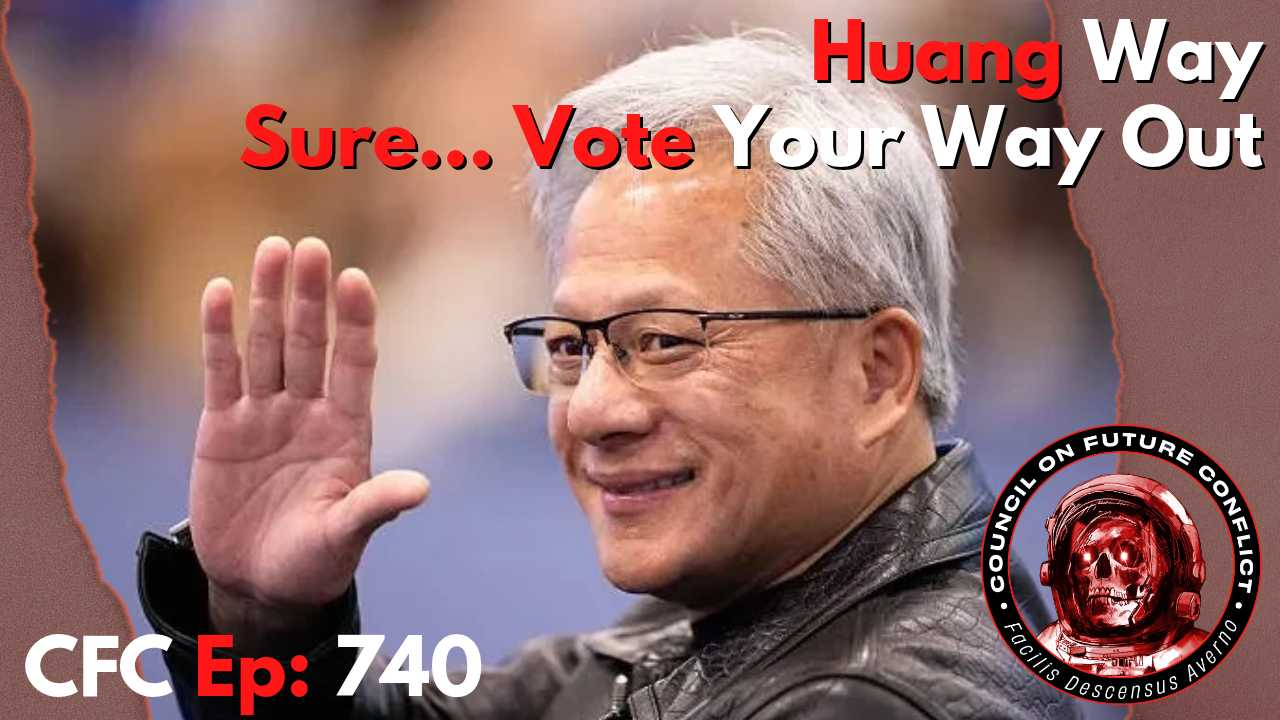
We still don't know what happened with Jensen Huang. The facts aren't settled, and I'm not going to pretend they are.
Here's the record this week. Nvidia's founder resigned as president, CEO, and board member, effective immediately. The board put CFO Colette Kress in as interim CEO. The Financial Times and the New York Times reported an affair with Alice Huang, a Chinese businesswoman, and that U.S. intelligence had been looking at her as a suspected Chinese spy. CNN says the intelligence collected so far does not prove she was acting as a spy for Beijing. Officials disagree about how strong the evidence is. Attorney General Todd Blanche said the Justice Department, he, and FBI Director Patel have reached no conclusion "around who she is or is not." President Trump put it in plain English: "Well, the big thing is, was the woman a spy? And I don't know if that's been determined yet." The FBI case is still open. Beijing called the accusations smears.
That is the factual floor. Everything after this is my read.
On today's show I said that if this had just been internal affairs, with no harassment or coercion alleged, he probably would have survived it. The spy allegation is what upset the apple cart. I also said this is not a normal executive departure. Huang built the company from almost nothing, ran it for 33 years, and left with no succession plan and no board seat. You don't get a clean swap when you pull a founder like that.
Nvidia makes a dual-use national defense tool. It is arguably the most important national defense tool of the coming century. Watcher made a point I want to keep: if you control technology that is going to change how the world works, China probably has a large team dedicated solely to compromising you. Joe's point: the prize may not have been a crate of chips. It may have been learning how we, as a defense industrial complex, actually use them, and how China could use that knowledge. The next 18 to 24 months of Nvidia chips are already spoken for. The hard problem is who gets the allocation, and whether a cutout in a country not on the banned list can stand up a cluster China can reach.
On the show I played Palmer Luckey: China wants Jensen out, so I want him in. I agreed with him. Some of the anti-data-center arguments work on me at a gut level. If I found out China was behind that campaign, I would flip. What is good for the Chinese Communist Party is almost never good for us.
That is where who benefits comes in. I don't claim I can prove a single mastermind. I do think you can see a coalition of interest, even if the people in it never sat in the same room.
One piece is the left-wing anti-AI crowd and the control freaks who travel with them. They want the models locked down, and they want the state or a few approved labs to decide who gets to run one. On the show we pointed to the network around Neville Roy Singham, a funder with well-reported China ties, as a driver of that push. I am saying the pressure was already there, and Huang was one of the loudest people in the industry arguing the other way: open access, open-weight models, and GPUs in regular people's hands. Watcher warned what a finance-only successor might do on day one: treat consumer GPUs as a rounding error and kill them. Take Huang out and that fight gets easier.
The other piece is the CCP. Even if Alice Huang is later shown to be a cutout rather than a recruited Ministry of State Security officer, that would not make the counterintelligence risk imaginary. Chinese law can compel citizens to assist the state. We looked at a Global Times piece framing his fall as proof that a white-dominated American power structure was excluding Asians from strategic businesses. I called that a Chinese information operation. The incompatibility is not "Asian." It is communist dictatorship.
After the show I watched the Moonshots livestream with Peter Diamandis, Salim Ismail, Alexander Wissner-Gross, and Emad Mostaque. (link here:
Peter opened with it directly: "Did Jensen self-destruct or was this a setup?" He later said, "I believe this was a takedown of Jensen orchestrated by a number of parties, in particular to the Chinese hawks on this side, whether it's just the Dems or any of the labs."
Alex said the thing I wish more coverage led with: "I'll say as a preliminary matter, we don't have all the facts yet. Obviously, we may never have all the facts." Then he asked cui bono. If a "silicon curtain" is coming down between the United States and China, he said, "Jensen was in some sense a permeable membrane through it. And there are probably many interests in ending that."
Emad was blunter. He said, "this has obviously been a setup," and in the same stretch: "nothing's been proven, there's been zero charges, zero evidence of him smuggling." Then the national defense point: Nvidia could "literally fall apart, which is something that is detrimental to America. And I'm sure that the Chinese and others will be very happy about, even if they do lose access to chips short term."
I don't know yet whether Alice Huang was a recruited spy, a cutout, or a messy personal disaster that became a counterintelligence case. I do know what happens if you weaken or wreck Nvidia at this moment. You weaken the U.S. compute advantage, scramble export controls and chip allocation, and put a defense-relevant supply chain at risk. You put America behind the eight ball in the one industrial fight we cannot afford to lose.
Palmer had it right, in my opinion. If China wants him out, I want him in.
Scott McCullough - Council on Future Conflict