Future Conflict
Politics • News • Writing
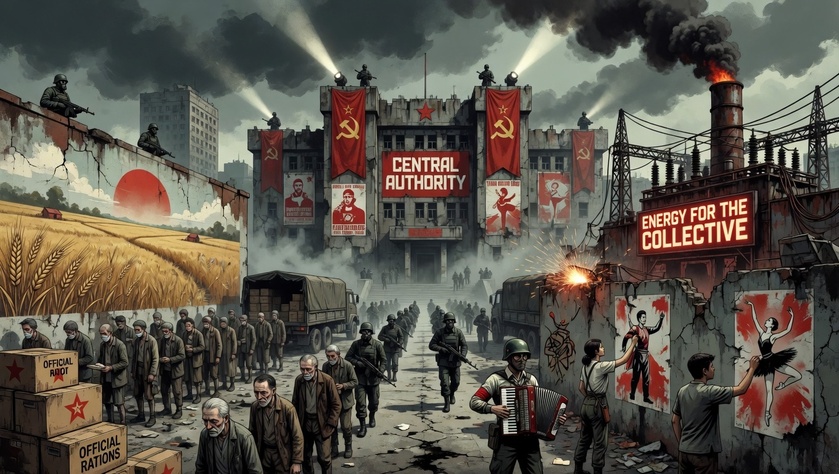
Socialism Doesn’t Corrupt. It Is Corruption
I continue the discussion from Episode 673
June 01, 2026
post photo preview
Screen cap from Episode 673

On Wednesday’s show (27 June 2026 - Link Here), we got into this one pretty good. We were talking about the raid on the Spanish Socialist Party headquarters, Pedro Sánchez’s crew, and how the opposition was calling it a “mafia system.” Joe and I were going back and forth, and at one point, I said something like, “It’s almost like communists are corrupt.” And then we started joking about “Dirty Sanchez,” but the more we talked, the less funny it got.

Because that’s the thing. It’s not funny. It’s the same damn story every single time.

We’ve all heard the line a thousand times: “That wasn’t *real* socialism.” Venezuela? Not real socialism. The Soviet Union? Not real socialism. Every time it fails, and it always fails, they tell you it was just the wrong people in charge, or outside interference, or it wasn’t done properly.

Bullshit.

On the show last week, we were looking at what’s happening right now in Spain with Sánchez. Police raiding the actual party headquarters of the ruling socialists. His wife under investigation. His brother under investigation. Former ministers caught up in mask contracts and kickbacks. And the response from the party isn’t “We’ll clean house.” It’s “This is a right-wing smear campaign.”

Sound familiar?

Then Joe pointed out something that stuck with me. He said these systems don’t just *allow* corruption, they’re built in a way that makes corruption the only rational way to operate once you’re inside. When the state controls the money, the contracts, the media access, the jobs, the permits… then the game isn’t about producing value anymore. The game is about getting close to the people who hand out the favors.

That’s not a bug. That’s the operating system.

We’ve talked on this show before about how the worst people rise to the top in these setups. Jim made a hell of a point when he said these guys aren’t even true believers half the time, they’re megalomaniacs using revolutionary language as a vehicle for power. And once they get it, the next group of megalomaniacs lines the last ones up against the wall and calls *that* the revolution.

We’ve seen the movie. The Soviet Union did it every twenty years or so. Venezuela turned into a straight-up criminal enterprise with Maduro sitting at the top like a mafia boss, according to people who actually studied it. Hundreds of billions disappeared while the country starved. Not because they got socialism wrong. Because once you give the state that much control over everything, the people who are best at lying, stealing, and eliminating rivals are the ones who win.

Last Wednesday, I brought up that old line from Hayek, the one about how the worst get on top in these systems. It’s not because socialists are uniquely evil as individuals. It’s because the system rewards exactly the traits that should disqualify someone from power: ruthlessness, willingness to break normal moral rules “for the greater good,” and total loyalty to the party over everything else.

We saw it with the Spanish socialists this week. We’ve been watching it in Venezuela for years. And if you think it can’t happen here, you haven’t been paying attention to how much of our own economy and institutions are already captured by people who treat political power as the only real currency.

Look, I’m not saying every single person who calls themselves a socialist is a thief. I’m saying the system they want to build *selects for* thieves, liars, and control freaks. It concentrates power in a way that makes normal human corruption scale up to industrial levels.

On the show, we joked about “Dirty Sanchez,” but the truth underneath the joke is ugly. When the same people who promise to fix everything are the ones running the whole machine, the fix is always more power for them. And more power for them always means more opportunities for the connected to steal.

That’s not corruption happening *to* socialism.

That’s socialism working exactly like it’s supposed to.

What do you think? Drop your thoughts in the comments or over on Locals. And if you want the full unfiltered version of these conversations, you know where to find the show.

Stay safe out there.


community logo
Join the Future Conflict Community
To read more articles like this, sign up and join my community today
1
What else you may like…
Posts
Articles
June 05, 2026

The story about the Youtuber who aborted his child because of Downs Syndrome hit a particular nerve for me and I wanted to share my story and why that is uniquely horrifying for me.

In 2022, my wife and I decided we wanted to have our first child, we tried and tried but were unsuccessful. We went to fertility doctors and they had us take some supplements, do some tests, and come back if we were still unsuccessful. A couple months passed and we were back discussing IVF/IUS and what the correct course of action would be: IVF.

Months of cycle tracking, expensive injections for my wife, and fighting with insurance, pharmacies, and the doctors later, the day for extraction came. It was a minor operation if a doctor’s office on the other side of DC from us. We got breakfast afterwards and walked around the local mall. It was pleasant until the email from the doctors came: 20 eggs extracted, 17 embryos created, 14 viable, 8 kept. I wanted to puke.

A few days later, we did the implantation procedure, had a ...

post photo preview
We will be back ... soonish.

We will be coming back online here in the not so distant future. Watch this space let me know what you guys want to see on here.

December 25, 2024

Merry Christmas everyone.

post photo preview
The Invoice Arrived in Ceuta

The Invoice Arrived in Ceuta

Council on Future Conflict


Last week on the Council we were already treating Ceuta as an open wound, but as we saw in the last 24 hours and on today's show, it is an angry infection with a violent natural antibiotic response. 

This week the residents went to the beach.

If you have been with this channel for a while, that is not a twist. That is a neighborhood clocking in for a shift Madrid advertised, then outsourced to rubber bullets and a Red Cross truck.

One thesis, three costumes. We imported a war, named it compassion, and acted shocked when it showed up speaking Spanish. Dearborn is the domestic end-state. Iran’s Marxists were the parable: they helped the revolution, then the revolution shot them, because that is what revolutions do with the help. Hormuz was the reminder that the shooting war did not pause so Madrid could have feelings. Ceuta was the demonstration. Now it is the invoice.

We said the 2016 caravans were not a humanitarian accident. They were a pulse aimed at a border. Europe ran the same play with a Mediterranean fence instead of a desert one. Combine the official religion of multiculturalism with a wave that does not assimilate, and you do not get a mosaic. You get replacement with better stationery.

Spain’s problem is not that the enclave is “complicated.” It is that Pedro Sánchez already sold the peninsula a regularization billed at half a million people living in the shadows. The window opened in April. Closed on 30 June. All you had to have to be eligible was five months on Spanish soil before the cutoff, no criminal record, and a one-year residence-and-work permit that renews. That is a backdated visa with a GDP speech attached. By close, more than a million applications were on the desk. Latin America filed most of the paper, Morocco and the rest of Africa filed enough of it. Call the party card socialist if you want the stationery. The faith is older: the state as priest of the open door.

The July pulse into an eighty-four-thousand-person city was the same policy wearing swim trunks. Madrid still wants credit for “managing” a seventy-thousand-person surge in two days while the capital is busy turning last year’s irregular stock into this year’s legal labor forecast. The people who live on that sand should be incensed. A country that once produced El Cid now has a premier treating a military-age beach camp as a demographic worksheet. Europe should read it as another domino, not a Spanish peculiarity. When the capital legalizes the stock and the enclave eats the surge, the rest of the Union is next in line to pretend the two files are unrelated.

Joe asked how many women were in the first wave. The answer on the sand was what it always is in these pulses: overwhelmingly military-age males with a press kit.

I put the moral stupidity in one line on the show:

“It’s almost like we want them to do exactly what they’re doing to us.”

That is the whole argument, if you are honest. Suicidal empathy is not kindness. It is a cover charge for a club that will not let you out. Look at who volunteers for the first bus. Then look at who is still standing when the committees adjourn.

Joe has been staring at the same zip code long enough to skip the TED Talk:

“I’ve been of that opinion for a very long time. About twenty-five years.”

Dearborn: reclaimable, or treat it like an infection that polite tools will not touch. We joked about napalm because that is what you say when you already know the official toolkit was fired into the ocean. Joe’s actual point on Europe was colder than the joke. Seville sent police to a border. Frontex, the EU service that exists so Brussels can say it has a border service, did not. The Union will issue a statement. It will not issue a unit.

If they do not see it as conquest, they see it as their right. They are not here to become Spanish. They are here to keep being what they were, with better benefits and a beach.

Watcher, when the state fails, keeps the ledger:

“None of the people in charge during that got any sort of punishment whatsoever… Most of them got promoted, in fact.”

He was talking about another American disgrace this week, because the pattern does not respect oceans. Nobody who opened the gate gets a reprimand. They get a title. Then the neighborhood gets the riot gear. In Ceuta, the police pointed the less-lethal end at Ceutíes so a camp could stay on the sand. If that does not tell you who the state thinks the problem is, you are not listening. You are fundraising.

What the last forty-eight hours actually were

Trampolín and Benítez, 26–28 August. Residents tore down tents and shacks. Belongings went into the fire and into the sea. Police fired warning shots and rubber bullets to keep the city off its own beach. Migrants pushed toward a pier. The night before, thousands in the street: invaders out. The chant that traveled: Ceuta no se vende, Ceuta se defiende. Un caballa nunca se rinde.

Then they sat down in front of the Red Cross. “Mafia,” they called it. Ugly word. Also a policy argument with the manners kicked off. If you keep feeding a camp that was never supposed to be permanent, it becomes a neighborhood. One local said it without a think tank: twenty-seven days of meals and they will not leave, because why would they. We do not fit.

Same stretch: about seventy people stoned a Spanish military vehicle. Soldiers left on foot and called police. Twelve Moroccan migrants arrested. At least one soldier hit. AFP said the motive was “not immediately clear,” which is wire-service for you, already-know.

Numbers, because officials like numbers more than beaches. Late July: more than seventy thousand irregular entries into an enclave of roughly eighty-four thousand. Most went back to Morocco. Madrid now says a few thousand remain, under 7,000 on a good briefing day. Local officials and aid counts have been saying closer to ten. Pick the press conference. Either way, this is not a processing center. It is a pressure cooker with a view of Africa.

X did what X does. The beach-and-fire clip racked up hundreds of thousands of views overnight. “A Ceuta native never surrenders” traveled with it. Treat that as the mood. Treat the Telegraph, AFP, and DW as the spine. We do not need the atrocity captions random accounts invented before breakfast. The beach is enough. The rubber bullets at residents are enough.

The Invoice

When a neighborhood takes a beach, that is not order. It is the autopsy of order. Side A will call it the border restoring itself. Side B will call it a riot with better slogans. Both are true, and both are an indictment. Last week we named weaponization, replacement, and suicidal empathy. This week the bill came due on Trampolín.

A caballa never surrenders is a good chant. It is a terrible substitute for a government. When the Red Cross needs a police escort to deliver bread, you are not having a migration debate. You are watching a state lose the only job it was hired to do.

Dearborn was the question: reclaimable, or orbit. Ceuta is the same question in Spanish, with a fence you can see from Morocco. Empathy that cannot say no eventually outsources the no to whoever still lives on the block. That is not a theory. That is Wednesday night into Thursday morning.

If the show does what this channel does, you will hear Madrid is managing it. Then you will hear the beach. Then you will hear the line Brussels will not put on a chyron: a city that has to chant it will not surrender has already been surrendered once.

If Spain will not summon El Cid, the neighborhood will keep doing the job with fire and a sit-in. Treat that as a European forecast, not local color.

Next seven days

  • Returns versus the remaining camp — does the number move, or just the podium?

  • A second night, then a third: one burned camp is a spasm. A week is a pattern.

  • Whether Rabat meters the pulse or cooperates.

  • Whether Madrid’s less-lethal is for residents, migrants, or whoever is on camera.

  • Whether Melilla and the Canaries watched the clip.

Read full Article
post photo preview
Four Factors of Future Civil Conflict (Updated 2026)
A grounded look at how energy, food, culture, and governance pressures are converging to shape future instability

Three years ago, I laid out a simple idea: things do not fall apart because of one problem. They fall apart when multiple systems start failing at the same time. That still holds up.

What has changed is the speed. The gap between stress and visible breakdown is getting shorter. You do not have to imagine failure anymore. You can see early versions of it in fuel prices, grocery bills, migration pressure, and the steady loss of trust in institutions that used to feel stable.

None of this is new in a historical sense. People do not change much. When access to basic needs or a sense of fairness starts slipping, behavior follows quickly.

The same four pressure points still matter most: energy, food, culture, and governance. The last few years have clarified how they interact and how fast things escalate when more than one starts to wobble.

1620008_rkeoh8opap8nywo_custom.jpeg
Energy / Fuel — The First Domino

Everything sits downstream of energy. This is not theoretical. It shows up in everyday life.

We saw a version of this in Sri Lanka when fuel shortages cascaded into broader collapse. Europe’s energy crunch after 2022 was not just about heating bills. It hit industry, jobs, and politics at the same time. You can debate causes, but the outcome was clear. People felt it immediately.

The United States has not hit that wall, but the warning signs are there. Refining capacity has not kept pace, the strategic reserve is lower than it was, and diesel continues to show volatility.

That matters because diesel is not abstract. It powers trucks, farming equipment, and logistics. When diesel spikes, it quietly raises the cost of everything.

If this category breaks hard, it will not be subtle. It will show up as outages, rationing, or prices that make normal life feel out of reach.

1620008_vfvfqstvcgwlxye_custom.jpeg
Food / Water — Where It Gets Real

People will tolerate a lot. Empty shelves is usually where that ends.

The last few years exposed how fragile the system actually is. War disrupted grain flows. Fertilizer constraints tightened supply. Disease culls reduced output. Policy decisions that looked minor on paper had real effects on production.

What stood out was not just shortages. It was who started pushing back. Farmers, truckers, and producers. The people who actually make and move things.

When those groups protest across multiple countries, it is not random. It is a signal that pressure is building in the wrong places.

Food inflation has already done damage, especially for lower and middle-income households. Water issues are quieter but more structural. Once those systems degrade, they do not recover quickly.

If this category slips, behavior changes fast. Hoarding, panic buying, political pressure, and eventually unrest.

1620008_cgemfql8csnyf3x_custom.jpeg
Culture — The Accelerator

This is the factor people tend to dismiss, and that is a mistake.

Culture is not just a social debate. It is how people define belonging, fairness, and what is worth defending. When that feels threatened, whether accurately or not, it becomes personal very quickly.

Across the West, similar tensions are emerging. Migration is outpacing assimilation in some areas. Trust between groups is declining. There is a growing perception that rules are not applied evenly.

In the United States, the divide takes a different shape but follows a similar pattern. Identity politics, demographic change, and a widening gap between institutional messaging and lived experience.

You do not need universal agreement on the facts. You only need enough people to feel that the system no longer represents them.

That is when fragmentation begins.

1620008_hx3431hyqqvva5b_custom.jpeg

Governance — The Breaking Point

Governments can absorb criticism. What they struggle to survive is a loss of legitimacy.

Once people believe the rules are uneven, or that enforcement depends on who you are, compliance starts to erode. It happens quietly at first, then more openly.

There are early signs of this now. Declining trust in institutions, debates over selective enforcement, and a sense that different groups operate under different standards.

At that point, people begin looking for alternatives. Sometimes that means local solutions. Sometimes it means parallel systems. Sometimes it is simple disengagement.

None of those paths support long-term stability.

Putting It Together

Each of these pressures is manageable on its own. Together, they compound.

Energy and food affect daily life. Culture shapes how people interpret stress. Governance determines whether people accept or reject the response.

The last few years did not break this model. They reinforced it.

What I’d Actually Do

Most discussions at this point become abstract. This does not need to be.

The focus should be on reducing fragility:

  • Build a buffer in essentials like food, fuel, and financial flexibility.

  • Know capable and reliable people in your local area.

  • Pay attention to leading indicators such as fuel costs, food prices, local crime, and policy shifts.

  • Avoid dependence on systems that only function when everything is working perfectly.

None of this is extreme. It is a practical response to systems that are showing visible strain.

Civil conflict is not guaranteed. But the conditions that make it possible are easier to recognize now than they were a few years ago.

Ignoring those signals does not make them disappear.

Read full Article
post photo preview
Service Guarantees Citizenship
Exploring the implications of a limited franchise

Several days ago we spoke on the FUTURE CONFLICT Channel about the notion of limiting the franchise to those willing to serve their country in one of many possible ways  


"Service Guarantees Citizenship" or SGC is a concept put forth by Robert A. Heinlein in his science fiction novel, Starship Troopers. This model of government ties citizenship to the military or other forms of service to the state. While it may seem controversial at first glance, there are several compelling arguments in favor of this system. It encourages civic engagement, instills a sense of duty and responsibility, and promotes a meritocratic society where those who have proven their worth through service are rewarded with the privileges of citizenship. However, there are also valid concerns about potential abuses of power, unequal representation, and the lack of diversity in perspectives and experiences within the political process. These criticisms are mostly a weak cry from the Diversity Equity and Inclusion crows but for the sake of argument I’ll address them in the spirit of “tolerance,” but first a word on democracy and its flaws. 


Looking at Europe and even some of our recent elections both at the state several criticisms of an unlimited franchise come to mind such as a lack of expertise in decision-making (Fetterman or FJB comes to mind), the rise of demagogues who manipulate the public opinion and use inflammatory rhetoric to gain power, and a lack of accountability, where elected officials are more concerned with pleasing the masses than with making difficult but necessary decisions.


These criticisms of an unlimited franchise raise valid concerns about decision-making expertise, the rise of demagogues, and a lack of accountability. These issues can lead to a degradation of political discourse, short-term thinking, and prioritization of popularity over long-term success. However, the SGC model offers a solution to these problems by ensuring that citizens have a vested interest in the success of their country through their service. This can create a sense of responsibility and expertise among citizens and can promote a focus on substance and policy rather than emotional rhetoric. Additionally, a service-based model ensures that elected officials are held accountable to those who have served, rather than just those who hold the power of a vote.


SGC is a concept put forth by Robert A. Heinlein in his novel Starship Troopers. The idea proposes that in order to earn the right to vote and participate in the democratic process, one must first serve their country in a meaningful way, primarily in military service but also in other forms. Here I will examine the advantages of SGC, as well as address potential criticisms and provide counterarguments. Ultimately, this analysis will allow us to better understand the implications of this proposed system and its potential role in shaping a strong and responsible society.


Among the benefits of SGC is the Creation of a strong sense of national identity and loyalty, the promotion of civic engagement and responsibility, and the Development of valuable skills and experiences.


In Starship Troopers, Heinlein argues that the act of serving one's country through the military or other forms of service creates a strong sense of national identity and loyalty among citizens. According to him, this sense of national pride and belonging is essential for the survival and success of any nation. As one character in the book states, "A nation is a living organism, and it must have a soul as well as a body, or it will perish."


Heinlein also contends that SGC promotes civic engagement and responsibility among citizens. Through their service, individuals learn the value of teamwork, discipline, and sacrifice for the greater good. They also gain a deeper understanding of the workings of government and the importance of active participation in the political process. As Heinlein writes, "Citizenship is an attitude, a state of mind, an emotional conviction that the whole is greater than the part, and that the part should be humbly proud to sacrifice itself that the whole may live."


In addition to fostering national identity and civic responsibility, SGC offers individuals the opportunity to develop valuable skills and experiences that can benefit both themselves and society as a whole. For example, military service can provide training in leadership, strategic thinking, and technical expertise, while other forms of service can offer hands-on experience in fields such as education, healthcare, or environmental conservation. As Heinlein writes, "The best way to learn a trade is to practice it in a real-world setting. The best way to learn leadership is to lead real people in real situations."


While some may argue that requiring service obligations for citizenship may limit the diversity of perspectives and experiences represented in government and society, this can be mitigated by ensuring that there are no arbitrary barriers to service that could disproportionately exclude certain segments of the population based on factors such as race, gender, or socioeconomic status. Additionally, those who choose not to serve are not necessarily excluded from participating in other aspects of society and can still exercise their civil rights as civilians.


Opponents of service-guarantee citizenship may weakly argue that a limited franchise model could be open to abuse by those in power who could manipulate the requirements for service in order to limit political participation and suppress dissent. However, a system that includes a mandatory course on moral philosophy and civic responsibility could help prevent such abuse by ensuring that citizens have a clear understanding of their obligations to society and are able to think critically and independently.


Throughout history, there have been examples of limited franchise models that have been successful in creating stable and prosperous societies. For example, the ancient Greek city-state of Athens limited political participation to male citizens who had completed military training. This model helped to create a strong sense of civic responsibility and national identity, and Athenian democracy is still celebrated as a seminal moment in the development of Western political thought. Similarly, the early United States limited political participation to male property owners, which helped to ensure that only those who had a stake in society had a say in how it was governed. While these systems were not without their flaws, they demonstrate that limited franchise models can be effective in creating stable and prosperous societies.


While democracy is often praised for its ability to give power to the people, it has also been criticized throughout history for a variety of reasons. One of the main criticisms of universal democracy is that it can lead to the tyranny of the majority, where the majority imposes its will on the minority without regard for their rights or interests.


Service Guarantees Citizenship presents a unique and innovative approach to governance that has the potential to address many of the challenges facing modern democracies. While the universal franchise has its merits, it is not without its drawbacks, including a lack of expertise, the rise of demagogues, and a lack of accountability. By contrast, Service Guarantees Citizenship offers a way to foster a strong sense of national identity, promote civic engagement and responsibility, and develop valuable skills and experiences.


Of course, there are potential pitfalls to this model as well, including the risk of creating a privileged class of citizens and the potential for abuse by those in power. However, by carefully designing and implementing such a system, these risks can be mitigated and the benefits realized.


Ultimately, the concept of Service Guarantees Citizenship represents a new and promising direction for democratic governance, one that recognizes the importance of service and sacrifice in building a strong and vibrant society. By adopting this approach, we can create a political system that is truly of the people, by the people, and for the people, one that is capable of meeting the challenges of our time and building a brighter future for us all.


Read full Article
Available on mobile and TV devices
google store google store app store app store
google store google store app tv store app tv store amazon store amazon store roku store roku store
Powered by Locals